
For five years, this blog has argued that medievalism is durably American. From Gothic synagogues in the South to killer queens in New Jersey, from Cajun jousters and the saints of New Orleans to the gargoyles of Perth Amboy, from rivalries on the Potomac to dragons and Vikings at seaside resorts, from late-blooming scholars on postage stamps to courtly love on General Hospital, American medievalism is rooted in an unresolvable clash of classical and medieval aesthetics, the persistence of religious traditions, and complex nostalgia for Europes that never were.
But did it have to take root in my garden?
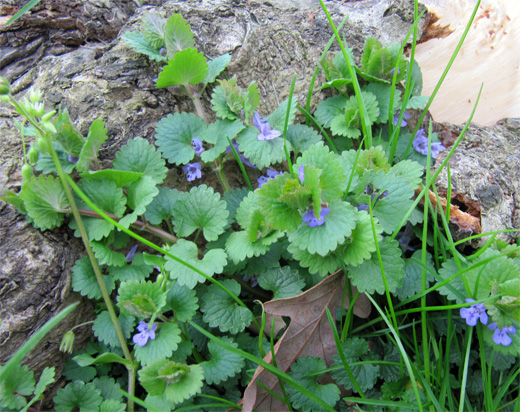
Meet Glechoma hederacea, the mint-like ground ivy called “creeping Charlie” in the United States and known, at least around my place, as “existence’s bane.” Rampant, sinister, nigh-unstoppable, this weed was brought to North America by early European settlers, who presumably appreciated its value as ground cover and its not-unpleasant scent.
Medieval people found Glechoma hederacea medicinally useful, as shown by a drawing of the stuff in a tenth-century manuscript from Constantinople. At the Metropolitan Museum of Art, you can buy a watch and other jewelry based on its depiction in a 15th-century woodcut, gifts apparently intended for people who’ve never torn intractable fistfuls of the stuff from the temperamental earth.
More interesting is its etymology in England, where it’s known as Gill-on-the-ground or, intriguingly, alehoof. Britten and Holland’s 1886 A Dictionary of English Plant-Names claims the word comes from “‘Ale-hoove,’ meaning that which will cause ale to heave, or work,” because in an era sans hops, the Anglo-Saxons used the plant to give their ale its bitterness. (The 2007 Dictionary of Plant Lore quips, too defensively, that “there have been other attempts at its etymology which may safely be ignored.”) The Bosworth-Toller Anglo-Saxon Dictionary finds the plant simply called “hófe,” with references to mersc-hófe, “marsh-hove,” túnhófe, “yard-hove,” brúnhofe, “brown-hove,” and phrases in medicinal texts such as genim hófan, “take hove.” If *ealu-hófe was an Old English word, no written trace of it survives.
The word may be gone, but the plant endures, creeping just beneath the soil, breeding pernicious new nodes as it roams. You can slow its advance, but smother it in mulch and it summons demonic strength and pushes ever upward. Like a neglected chip of pure evil smoldering in a toaster oven, alehoof is almost impossible to eliminate. “[P]ut every scrap of the plant in a bag and throw it away,” one site advises, “or it will reroot and take over again.” Other sites suggest tracing the runners several feet to their origin and, like Beowulf before you, destroying the monster’s mother, even if doing so leaves craters in your lawn.
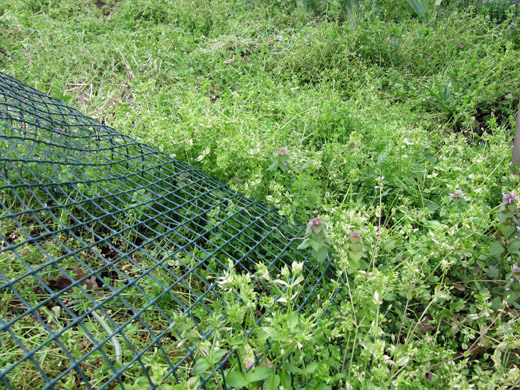
Whatever medicinal purposes medieval people found in alehoof, it’s now thought to be toxic in large amounts. And don’t be fooled by those dainty, bumblebee-pleasing flowers; when alehoof goes berserk, as it did in a neighboring plot, it can help bring down an unsturdy fence.
It’s enough to make a despondent gardener fall back on an Old English plea to the forgotten goddess Erce:
Geunne him,
ece drihten,
(and his halige
þe on heofonum synt),
þaet hys yrþ si gefriþod
wið ealra feonda gehwaene,
and heo si geborgen,
wið ealr bealwa gehwylc,
þara lyblaca geond land sawen.
[“Grant to him, eternal ruler (and his holy ones, who in heaven are), that his ploughing be protected against any and all enemies and it be guarded against each and every evil, against those spells sown through the land.” trans. K.A. Laity]
Or maybe, in the proper spirit of the Anglo-Saxons, magic needs to surrender to stoicism: hófe bið ful araed. Like medievalism, alehoof has taken perennial root; from gift shops to gardens, it isn’t fated to fade.
 Quid Plura?

Alehoof: great name. I actually like creeping Charlie better than the Cooperstown menace, bishop’s weed.
LikeLike