
 “Excuse me, sir?”
He’s probably ten, but he’s small for his age. His purple ball has rolled into unbusy State Street, and while he’s forbidden to step off the curb, apparently he is allowed to talk to strangers.
“Can you please throw me that ball?”
I do. He’s polite enough not to tell me I’m a strange sight on a Sunday afternoon. Subdued salsa from Puerto Rican cookouts drowns out the car noise. People are chatting; it’s too hot to dance.
“Takin’ pictures, huh?” He holds his ball under one arm and glances at the sky. “You know what would make a good picture? Those gargoyles up there. They’re awesome.”
He’s right. They see everything in Perth Amboy.
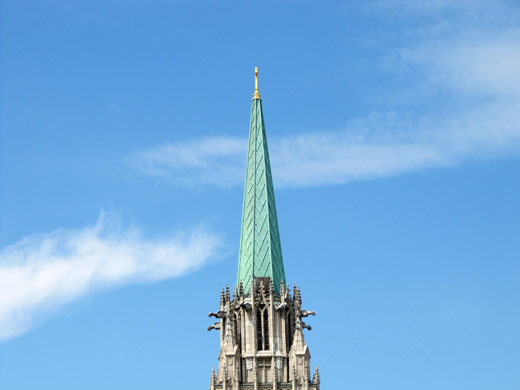
Built in 1919 by and for the Polish Catholics of Perth Amboy, St. Stephen’s Church is a fine example of American neo-Gothic, but despite its intricacy, it’s bereft of grotesques—except for the huge faux-gargoyles below the spire.
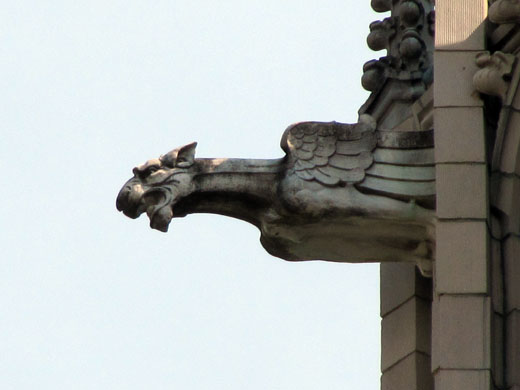
Weirdly, I can’t find any public information about the architect, but whoever he was, he didn’t Americanize this church, nor did he grant its parishoners (who still run a Polish CCD) a speck of Slavic idiom. No, the mind behind St. Stephen’s adored Western Europe; those gargoyles would be right at home on a cathedral like Bayeux.
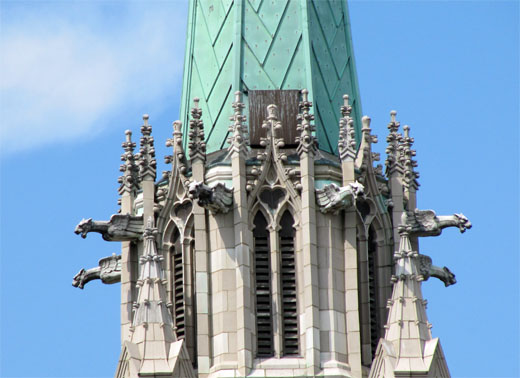
Though these gargoyles seem like relics of the city’s better days, prosperity alone doesn’t explain them. In the late 19th and early 20th centuries, when neo-Gothic building was rampant, Perth Amboy was a gargoyle breeding ground. A local abundance of rich clay here and in nearby Woodbridge and New Brunswick meant that Perth Amboy firms like A. Hall and Sons (later the Perth Amboy Terra Cotta Company, later Atlantic Terra Cotta) made grotesques and ornamentation for buildings across the United States, providing decorations for the Woolworth Building, exterior details for the Philadelphia Museum of Art, and the entire roof of the U.S. Supreme Court.
So whose idea were the gargoyles of St. Stephen’s? A 1906 Architectural Record article shows similarly slender beasties made by the Perth Amboy Terra Cotta Company on the first City College of New York building, a neo-Gothic landmark by architect George B. Post.
Then again, Charles Follen McKim of the legendary firm McKim, Mead, and White had attended school in Perth Amboy, and he partnered with the Perth Amboy Terra Cotta Company to make multicolored brick when brownstone and red brick fell out of fashion. It’s tempting to see St. Stephen’s as a “forgotten” work by MM&W or one of the many architects associated with them, but then what if it’s a great Gothic sob by the fanatically medievalist church designer Ralph Adams Cram? Or maybe it’s a monument to the faith of an architect no one has thought to remember.
I asked the folks at St. Stephen’s if they know who built their church; I’ve yet to hear back. Regardless, I’ll bet that like the kid who pointed them out to me, the gargoyles of Perth Amboy were locally born—a hundred years distant, but raised in an age that perceives the medieval wherever you look.
 Quid Plura?
You’ve probably already considered the Perth Amboy Public Library for a starting point in research. My money, though, is on Domingo Mora as the sculptural designer, who was a major figure at the terra cotta manufactory you mention. Domingo Mora, a noted sculptor from Catalonia, married Laura Gaillard, a cultured French woman originally from the Bordeaux region of France. (There’s the Western European connection to which you allude.) They lived in Uruguay, which they left during an insurgency in 1877, and went to Catalonia. Apparently, however, they abandoned Europe and “in 1880, they arrived in New York City, and quickly relocated to Perth Amboy, New Jersey, where Domingo Mora accepted a position with the A.H. White Terra Cotta Company, which was renamed The Perth Amboy Terra Cotta Company.” From: http://www.auctionflex.com/showlots.ap?co=58300&weid=13852&weiid=0&archive=y&lso=lotnumasc&pagenum=1&action=print&lang=En
There were other sites that mentioned much of Mora’s background, but this one has a good bit of info.
Here’s another link in re Mora not receiving credit for his work: http://query.nytimes.com/mem/archive-free/pdf?res=F00A15FE3A5F13718DDDA10994DF405B848CF1D3
Finally (apologies for so many links!), http://terrymurray.blogspot.com/2009/06/i-spy.html has something pertinent to say.
I’m fond of gargoyles myself. My curiosity grew, as I began looking about the interwebs after you mentioned the mystery. I lived in Cincinnati for a time, too, a city where the beasties are a beloved part of the population and can be found on many of the buildings. You should go to Ohio and visit them if you have not already.
Pursue the topic. It’s fascinating. Write another book.
LikeLike
Thanks for the thoughts! I have a limited amount of time to research this further, but I will check with the good people at the Perth Amboy library and a couple of New Jersey historical societies. (And perhaps someone who knows the answer will land here via the magic of Google and let us know.)
I’d also want to distinguish, as you do, between the architect of the church and the sculptor of the actual gargoyles. There may be not one but several intertwined stories here about someone’s fondness for medieval motifs.
LikeLike
The possibility of Mora as sculptor so captivated me that I was completely and happily lost in that aspect. But, yes, the architect! The one who conceived of the whole enterprise is certainly a critical component and so sad such info is not easily divined.
As you note, your research hours are at a premium, but maybe you can investigate in spare minutes and share whatever you are able to discover as time permits.
LikeLike