
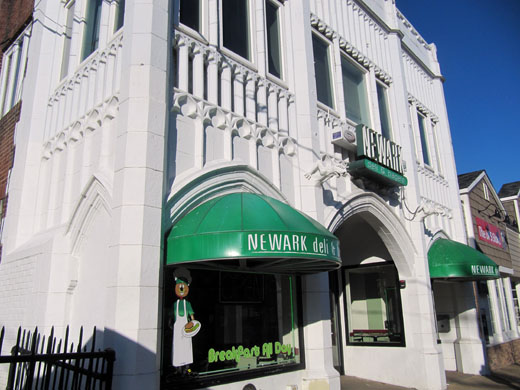
When you’re young, it’s easy to miss the obvious. Skulking around the University of Delaware in days of yore, I wasn’t unaware of this building on Newark’s Main Street, just footsteps from the campus—but I didn’t appreciate its striking Gothic facade, and until last weekend I hadn’t really looked at…

…the canine gargoyles on either side of the entrance.

Now prospering as Newark Deli and Bagels, the storefront at 36 East Main Street began life in 1917 as the Rhodes Pharmacy. The building was designed by Richard A. Whittingham, an architect of the Maryland division of the Pennsylvania Railroad. (His other works include a now-gone greenhouse on the U.D. campus and the reviewing stand for William McKinley’s 1897 presidential inauguration.)
I’ve not yet found reason to believe that either Whittingham or his client, pharmacist George W. Rhodes, were gung-ho for Gothic architecture—but maybe this cool little building says it all. (It used to have parapets!)
By 1917, American Gothic was passing its prime among church architects even as it picked up steam among the designers of college campuses. Its use on a commercial building is rare enough to earn 36 East Main Street a spot on the National Register of Historic Places—but I’m convinced that the gargoyles of Newark, Delaware, were influenced by a much grander building thousands of miles away.
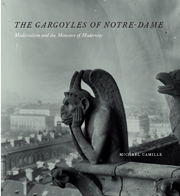 Notre-Dame de Paris! Its gargoyles are iconic—especially the bitter critter on the cover of this book—but even many medievalists aren’t aware that he and 53 of his fellows aren’t medieval at all, but the products of an ambitious 19th-century restoration.
Michael Camille tells this story well in The Gargoyles of Notre-Dame: Medievalism and the Monsters of Modernity. By the 1840s, Notre Dame was a ruin; the cathedral had been cursed as a symbol of medieval irrationality, denuded of royal statues and other symbols of féodalité, and wrecked by weather and time. In 1843, in the wake of Victor Hugo’s fictional tribute to the cathedral’s former glory, architect Eugène-Emmanuel Viollet-de-Duc began restoring Notre Dame—which included commissioning sculptors to create the replacement monsters he dubbed chimères. Camille documents how these modern “chimeras” entered European and North American popular culture through engravings, etchings, photographs, postcards, paintings, and books—and how quickly the world forgot that they weren’t medieval creatures at all.
The 54 chimeras are a lurid lot. Partly inspired by France’s 19th-century fascination with Egypt, their fellowship includes demonic birds, a goat, an elephant, a pelican, a wild boar, a two-headed dog, a (now destroyed) unicorn, and (lamentably) a Wandering Jew. Most of them, though, are humanoid animals—which brings us back to the dog-faced beasties of Newark, Delaware.
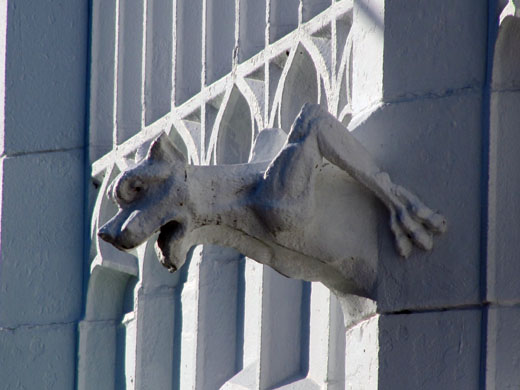
Look at this fellow, and then consider a few of the chimeras from Notre Dame:
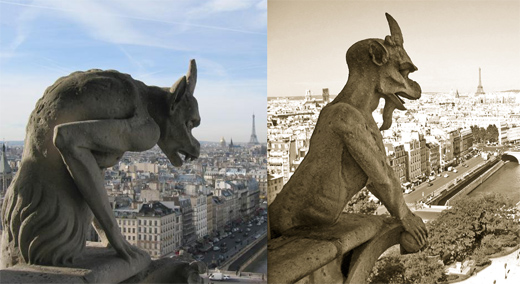
(Above left: Michael Reeve, via Wikimedia Commons; above right: Chosovi, via Wikimedia Commons.)
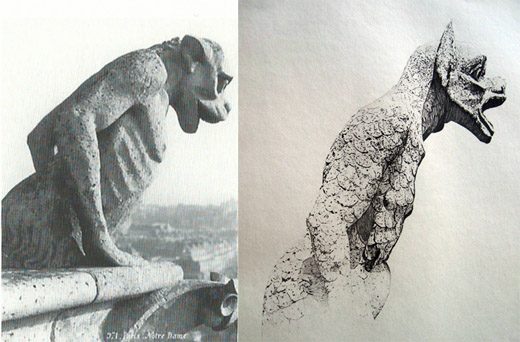
(Above left: vintage postcard of the “ape-satyr”; right: John Taylor Arms, “A Devil of Notre Dame,” c. 1929)
The Newark grotesques don’t look like any one of the chimeras on Notre Dame, but they’re arguably a loose composite of several of them. Those big, bent arms that allow the creature to lean menacingly forward are common to several of the chimeras, and we could easily build the (relatively tame) faces of the 1917 Delawareans from the ears, mouths, brows, and noses of some of these 19th-century forebears.
So did Richard Whittingham or George Rhodes dream, like Miniver Cheevy, of medieval glory?
Did they see the Notre Dame chimeras in illustrations of Victor Hugo’s Hunchback of Notre Dame? Or in the paintings of Winslow Homer? In the photography of Alvin Langdon Coburn? On postcards from family and friends?
Are Newark’s chimeras barking in defiance of home-grown architectural forms? (Weirdly, these creatures came to life the same year the University of Delaware settled on Colonial Revival, a sensible but decidedly un-Gothic style that still predominates across the campus.)
Or maybe Rhodes considered his pharmacy a cathedral and saw his work as a sacred calling?
The fun thing about American medievalism is that there’s rarely a single reason for this stuff. Just as people in 2013 have complicated motives for studying, idealizing, or reenacting the Middle Ages, Whittingham and Rhodes might have offered explanations that combined the personal, the social, the religious, and the political.
Twenty years after ignoring 36 East Main Street for reasons I’ve long since forgotten, I’m glad I looked up. You never know when the place where you first met Charlemagne and Chaucer will reveal to you, just over your head, the bewildering traces of somebody’s medieval dream.
 Quid Plura?


What a strikingly beautiful building. Those gargoyles are quite prominent. (I think at Halloween the counter-staff should dress up like one and just pop-up from behind the counter). Try eatin’ your pastrami and rye now ; )
The arches are incredible too! Boy I wish architects were still designing this way. Great photos too. You have a good eye.
LikeLike
And wouldn’t it be nice to have a cathedral of pharmacy…
LikeLike