
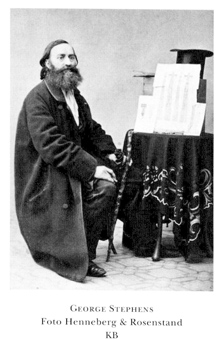
“[P]ioneering, erratic, and irascible”—that’s how scholar Andrew Wawn introduces a medievalist I’d never heard of, apparently because his spectre haunts only a few narrow stacks in Scandinavian libraries. Although George Stephens published more than 500 books, articles, pamphlets, translations, and plays, his Wikipedia entry is a sorry 120 words long, and it isn’t likely to be lengthened or annotated by legions of Tolkienesque fans. Even so, Wawn’s engaging 1995 article about him—“George Stephens, Cheapinghaven, and Old Northern Antiquity”—makes an amusing but sympathetic case for looking back at scholars of yore-days and seeing not pitiable caricatures, but weird, vivid, quizzical lives.
Wawn calls George Stephens “a fascinatingly marginal figure, an exile by choice, a rebel by temperament, cocooned in his book-lined Copenhagen study glowering across the North Sea at the (in his view) wretched condition of England.” Born in England in 1813, Stephens moved to Sweden in 1834 to teach English before taking a lectureship, and then a professorship, at the University of Copenhagen. (Hearken, jobless scholars! Three years earlier, the enterprising Stephens circulated an English-language pamphlet with the efficacious title Hurrah for Denmark.)
Stephens is one of many unsung souls who hammered out the cogs of the medieval-studies machine. He was an influential collector and classifier of folk tales, his work on runic inscriptions founded a sub-field, and he published the first translation of an Icelandic saga into English—albeit from Swedish. “He translated Icelandic sagas,” Wawn writes, “while contributing to their reoralization by writing saga-based parlor songs; he taught Shakespeare whilst himself writing plays on Viking subjects in Elizabethan style; and he contributed vigorously and unashamedly to popular polemics, finding it no mark of virtue to proclaim the virtues of a democratized literary-critical process in an impenetrable and robotic meta-language.”
He’s also easy to mock. Wawn devotes most of his article to Stephens’ virtually unread 1857 play, Revenge, or Woman’s Love, in which King Edgar of Mercia is waylaid by Vikings while on pilgrimage to Sweden, where he’s forced to summon his wife to be sacrificed to Odin. Wawn is patient with Stephens’ “pyrotechnic display of newly minted compounds, anaphoric elaboration, and (alas) syntactic congestion,” and I enjoyed picturing the climax featuring “the return of the cave-dwelling witch, accompanied by much smoke and many explosions,” but why snicker? “Notwithstanding its breathless and somewhat confusing denouement,” Wawn says, “there is much spirited and good-humored writing in the play, and it would be ponderously sobersided to miss the element of jeu d’esprit which helps to drive the whole work.”
What Wawn does here is humane. Seeing an eccentric medievalist rendered all the more comical by time, Wawn doesn’t “deconstruct,” “interrogate,” “negotiate,” or (good Lord) “problematize” him. Instead, Wawn peers into a bundle of contradictions—”the English Anglophile exiled in Scandinavia, the modern Christian fundamentalist fascinated by ancient paganism, the British Tory radical who translated a treatise in favor of an hereditary Danish monarchy”—and in 40 pages, reckons his humanity.
To my surprise, Wawn contrasts Stephens with another philologist whose life and work were shaped by Mercia. “George Stephens, it need hardly be said, was no Tolkien,” he admits, “and Revenge, it need hardly be added, is no Lord of the Rings. The play could number its nineteenth-century readers in tens, and its twentieth-century ones on the healthy fingers of a severely maimed hand.” I laughed at that line, because it’s tempting to see Stephens as a prevenient Ignatius Reilly bumbling around Copenhagen, crusading for influence, obsessed with tomorrow’s obscurities, repelling his colleagues with political rants. It’s harder, but kinder, to place this minor scholar alongside a famous one, in an article that’s more subtly and sensitively written than anything its subject could have mustered, and not lose him in the shadow.
“That one should succeed commandingly whilst another fails eccentrically needs (and finds) no explanation in the self-preoccupied world of modern literary theory,” Wawn concludes. “We might rather look to the chaos theory of real human lives.” In his choice of subject and through his own example, Wawn affirms something that isn’t always clear: there are people behind the scholarship we read.


Perhaps we can blame the overcoat?
LikeLike
It gets cold in Denmark, man!
LikeLike
Hi Jeff–
Thanks for finding me in Twitterica–enjoyed this post and will come back for more…
LikeLike