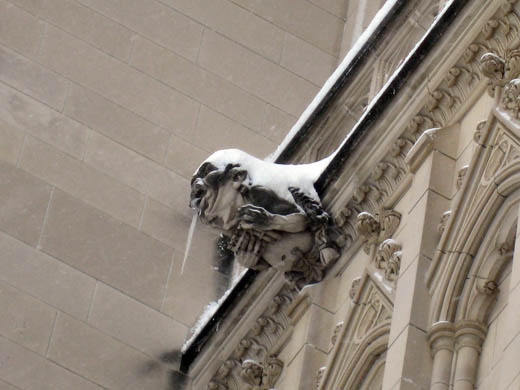
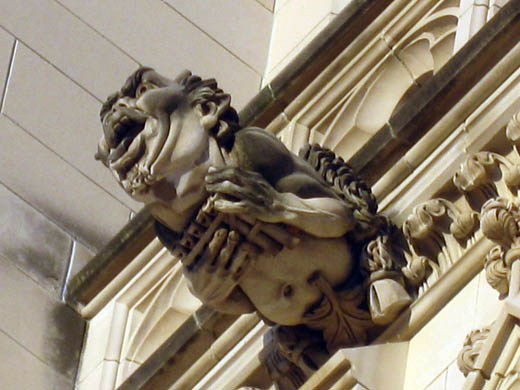
← “And as the nail sunk in the cloud…”
“Drawn into the stream of undefined illusion…” →

“And the little wheel runs on faith…”

Tourists never notice it, but then neither do most locals. Behold: Alto Towers, catty-corner to the National Cathedral at 3206 Wisconsin Ave NW.

Alto Towers went up in 1932, in the heyday of D.C. suburbanization. This eight-storey apartment house is the work of Arthur B. Heaton, a half-forgotten architect who’s partly responsible for the look and feel of northwest Washington—and who was, briefly, an unabashed medievalist.

Heaton was ridiculously versatile. In 1901, he built Tudor Revival apartments and later designed the Altamont, a local apartment house with an Italian Renaissance twist. In 1914 and 1931, he put Classic Revival additions on the National Geographic Society building. In 1926, he gave his (now-demolished) Capital Garage a funny, car-themed facade, and his interest in the automobile led him to design our local “Park and Shop,” the prototypical strip mall, in a Colonial Revival style. Heaton oversaw the construction of new facilities on the GWU campus while also designing banks, churches, and countless other D.C. buildings and homes, apparently without ever developing an identifiable “Heaton style.”

…and that’s what makes Alto Towers a treat for the medievalist. Take a gander at the entryway.

When Heaton wasn’t serving as president of the local chapter of the American Institute of Architects, co-founding the Washington Building Congress, or spearheading the “Renovize” movement during the Depression, he was also, from 1908 through 1920, the supervising architect for the National Cathedral, where he helped chief architect Henry Vaughan oversee construction during the cathedral’s first 12 years.

In 1932, more than a decade after Heaton’s time there, the cathedral was little more than an overgrown apse festooned with a few angelic grotesques. Given a chance to design an apartment house across the street, Heaton—who could have built damn near anything—set loose his inner medievalist.

Those snarling, gargoylish grotesques are the most blatantly cool thing about Alto Towers, but the whole arcaded entryway is a neo-medieval romp.

The quatrefoils (four-leaf clovers) in the spandrels (the warped triangles above each arch) are pretty standard, but those thick, gabled supports are an architect’s fancy. Each one resembles a cathedral buttress while also containing blind tracery of a Gothic arch.

At Alto Towers, periods and cultures trip over one another and have a good laugh. The pine cone finials hark back to ancient buildings and the medieval fascination thereof, while those funny little nubs at the tops of the smaller arches—including the little ones in the triforium, the upper row—strike me as very American. Meanwhile, on both sides of the interior of each large arch are squared, Art Deco-ish shadows of Corinthian columns. Behind them, the brick-lined inner doors whisper “Cordoba” in an American accent.

Most of Alto Towers is plain brick, but Heaton decorated just enough of its topmost level to show that the neo-medievalish entryway wasn’t an afterthought.

Note the two types of ornamented shield. They may be purely decorative, but I’ll gladly send a free book to any heraldry buff who can show that they’re meaningful.

While Heaton’s 1926 Capital Garage (PDF with photo) featured large, leonine gargoyles, Alto Towers is his full medievalist statement, the rhapsody of a restless architect who knew he wouldn’t live to see the cathedral completed.

When Heaton died in December 1951 at 76, the new apartment buildings rising around the cathedral were blocky and bland. Today, tourists tromp right past them, fixated on the promise of sighting quirky gargoyles on the Gothic spires beyond.

Of course, the cathedral’s first proper gargoyles weren’t put in place until around 1960, so if the beasties at Alto Towers forever bare their fangs, I can’t really blame them. No one remembers that they were here first.

Sunday, June 6, 2010, 12:02 am in gargoyles/grotesques, medievalism, National Cathedral, Washington | No Comments »

Leave a comment:

(Comments with links may be held briefly for moderation.)

  • Quid plura?

    "Quid plura?" is the blog of Jeff Sypeck, a writer in Washington, D.C.

  • Becoming Charlemagne is available as a Harper Perennial paperback. Order a copy here.

  • cover
  • Looking Up: Poems from the National Cathedral Gargoyles is now available! Order a copy from Amazon or learn more here.

  • cover
  • Folklore! Chivalry! Mad alliteration! The Tale of Charlemagne and Ralph the Collier: A Translation is available in paperback and as a Kindle e-book.

  • cover
  • Archives

    • May 2013
    • April 2013
    • March 2013
    • February 2013
    • January 2013
    • December 2012
    • November 2012
    • October 2012
    • September 2012
    • August 2012
    • July 2012
    • June 2012
    • May 2012
    • April 2012
    • March 2012
    • February 2012
    • January 2012
    • December 2011
    • November 2011
    • October 2011
    • September 2011
    • August 2011
    • July 2011
    • June 2011
    • May 2011
    • April 2011
    • March 2011
    • February 2011
    • January 2011
    • December 2010
    • November 2010
    • October 2010
    • September 2010
    • August 2010
    • July 2010
    • June 2010
    • May 2010
    • April 2010
    • March 2010
    • February 2010
    • January 2010
    • December 2009
    • November 2009
    • October 2009
    • September 2009
    • August 2009
    • July 2009
    • June 2009
    • May 2009
    • April 2009
    • March 2009
    • February 2009
    • January 2009
    • December 2008
    • November 2008
    • October 2008
    • September 2008
    • August 2008
    • July 2008
    • June 2008
    • May 2008
    • April 2008
    • March 2008
    • February 2008
    • January 2008
    • December 2007
    • November 2007
    • October 2007
    • September 2007
    • August 2007
    • July 2007
    • June 2007
  • Categories

    • applied paleobromatology (6)
    • Arthuriana (13)
    • Balkans (5)
    • Beowulf (10)
    • Best of 2007 (1)
    • Best of 2008 (1)
    • Best of 2009 (1)
    • Best of 2010 (1)
    • Best of 2011 (1)
    • Best of 2012 (1)
    • Best of the First Five Years (1)
    • bookstores (4)
    • Bulgaria (1)
    • Byzantium (1)
    • Caucasus (3)
    • Charlemagne (46)
    • Chaucer (12)
    • Dante (3)
    • Delaware (3)
    • England (3)
    • France (1)
    • galangal (2)
    • gardening (5)
    • gargoyles/grotesques (66)
    • Georgia (3)
    • Germany (4)
    • Iceland (21)
    • Iowa (1)
    • Ireland (2)
    • Kansas (1)
    • literature (79)
    • Lloyd Alexander (31)
    • Longfellow (2)
    • looking up (55)
    • Louisiana (18)
    • Mark Twain (1)
    • Maryland (7)
    • medieval shark week (1)
    • medievalism (128)
    • Merovingians (1)
    • Minnesota (1)
    • miscellaneous (110)
    • Missouri (1)
    • National Cathedral (70)
    • New Jersey (19)
    • New York (7)
    • Old English (13)
    • philanthropy (3)
    • philology (5)
    • politics (13)
    • Rome (1)
    • Scandinavia (1)
    • SF/fantasy (17)
    • Shakespeare (1)
    • Sir Gawain (5)
    • statues (21)
    • teaching (10)
    • Tennyson (2)
    • Theodulf (9)
    • Tolkien (5)
    • translations (17)
    • travel (9)
    • videos (4)
    • Virginia (5)
    • visual arts (1)
    • Washington (46)
    • Washington Irving (3)
    • writing (30)
  • Contact

    • jeffsypeck -at- gmail.com


Quid plura? © 2007 All Rights Reserved. Hosted by ThatHostingPlace.com.
Entries (RSS) and Comments (RSS).

This blog uses a modified version of the ShinyRoad 2.1 WordPress theme by Nurudin Jauhari.